

Retail Development Consultant
Hotel to Senior Housing Conversion in the San Francisco Bay Area
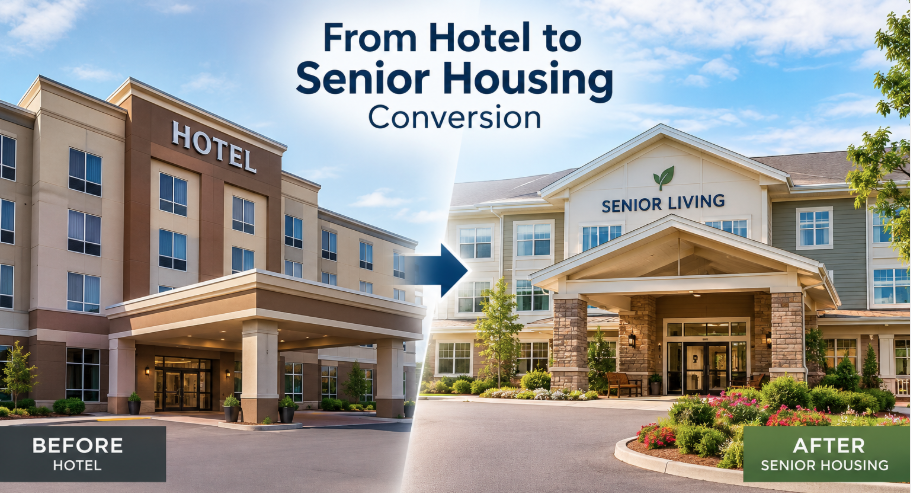
Converting an existing hotel into senior housing can create a practical development opportunity when a property no longer performs well as a traditional hotel. Developers looking to convert hotel to senior housing are increasingly evaluating adaptive reuse as hotel distress, changing market conditions, and high construction costs affect real estate decisions. Hotels can also offer useful physical features for senior housing. Guest rooms may provide a starting point for resident suites, while existing dining areas, kitchens, common spaces, elevators, and other infrastructure may support a new use. Still, conversion is not simply a matter of changing the property's purpose. A successful project requires careful review of market demand, zoning, building systems, life-safety requirements, licensing, financing, and total development costs. Evaluating these factors early can help determine whether conversion is more practical than continued hotel operations or ground-up senior housing development.
Feasibility Factors for Hotel-to-Senior-Housing Conversion
Before acquiring or repositioning a hotel, developers should complete a detailed feasibility review. Several factors can influence whether the property can support a successful conversion.
Market demand analysis:
Local senior demographics, household income, competing communities, occupancy rates, and the availability of senior living options should be reviewed. The target resident group also matters. Independent living, assisted living, and other senior housing models can have different space and service requirements.
Zoning and permitted use:
A hotel's existing hospitality zoning does not automatically make the property eligible for assisted living or another senior housing use. Local regulations may require a conditional-use approval, zoning change, entitlement process, or other municipal review. Parking, density, setbacks, and accessibility standards may also affect the development plan.
Fire and life-safety systems:
Senior housing can have different life-safety requirements than hotels. Existing fire alarms, sprinklers, emergency exits, electrical systems, elevators, and other building components may require upgrades. Depending on the planned use, a nurse-call system and additional emergency infrastructure may also be needed.
Building layout and functionality:
Existing guest rooms can sometimes be adapted into resident suites, but room dimensions and bathroom configurations need to be reviewed. Dining rooms, kitchens, lounges, meeting spaces, and outdoor areas may also be assessed for their potential senior living use.
Historical designation limits:
A historic hotel can offer architectural value, but its designation may limit changes to windows, façades, entrances, interior features, or other elements. Preservation requirements can affect design flexibility and construction costs.
Conversion costs versus ground-up development:
The acquisition price alone does not determine whether a conversion makes financial sense. Developers should compare renovation, entitlement, design, licensing, and construction costs against the cost of building a new senior housing property.
A thorough Hotel Conversion to Senior Housing analysis brings these factors together before substantial capital is committed. It can help identify physical limitations, regulatory challenges, potential advantages, and the likely scope of the conversion.
Our Hotel to Senior Living Conversion Process
A well-defined process helps developers understand the project from acquisition through operation. RGQ can help coordinate the development strategy while working with appropriate architects, consultants, legal professionals, operators, and other specialists.
Acquisition & Feasibility:
The first step is to evaluate the property, location, market, existing improvements, zoning, acquisition economics, and potential senior housing model. This stage helps determine whether the hotel presents a reasonable conversion opportunity before major commitments are made.
Design & Life-Safety Upgrades:
Once the project demonstrates potential, the existing building can be assessed against the physical requirements of the proposed senior living use. Design work may include resident rooms, common areas, accessibility improvements, fire protection, emergency systems, plumbing, electrical work, elevators, and nurse-call infrastructure.
Licensing:
Senior housing operations may require approvals and licenses that are not applicable to hotels. The proposed use should be evaluated against applicable state and local requirements. Licensing considerations should be addressed during planning so they do not become an afterthought late in the development process.
Operator Transition:
The future operating model should be considered throughout development. Resident services, staffing, programming, dining, common areas, and operational circulation can all influence the final design. Coordinating with an experienced operator can help connect the physical property with the needs of future residents.
Financing Hotel-to-Senior-Housing Conversions

Financing is a central part of evaluating a hotel conversion. A project may involve acquisition costs, design expenses, entitlement work, construction, life-safety improvements, professional fees, operating reserves, and other costs before the property generates stabilized income. The financing structure should therefore be considered during the initial feasibility stage.
For qualifying affordable senior housing projects, Low-Income Housing Tax Credits (LIHTC) can be an important source of equity. LIHTC programs are designed to support eligible affordable rental housing, and projects must meet applicable program requirements. The potential use of LIHTC depends on factors such as the proposed project, affordability structure, location, and applicable program rules.
Historic tax credits may also be relevant when an eligible historic hotel is being adaptively reused. These programs can potentially help offset certain qualified rehabilitation costs, subject to applicable federal or state requirements and approval processes. Historic status should be reviewed early because preservation requirements can influence both design and project economics.
RGQ can also evaluate joint venture structures and institutional capital opportunities when appropriate. Its experience with development partnerships and institutional relationships can support a coordinated approach to acquisition, development, and capitalization. Conversion project financing should be assessed alongside the property's projected operating performance, renovation budget, market demand, and overall development strategy.
Why Partner with RGQ?
A successful conversion requires an understanding of both the existing hotel and the proposed senior housing use. RGQ brings experience in hotel development and asset management as well as senior housing development, creating a broader perspective when evaluating adaptive reuse opportunities.
This dual experience can be valuable from the earliest stages of a project. Hotel development knowledge can help with property evaluation, acquisition strategy, repositioning, and understanding existing hospitality infrastructure. Senior housing development requires a different set of considerations, including resident needs, accessibility, operating models, regulatory requirements, and long-term market demand.
RGQ has more than 30 years of commercial real estate experience. During Robert G. Quintero's career, he and his partners owned and operated more than 4 million square feet of retail malls nationally. He has also personally negotiated leases totaling more than 1.28 million square feet, including major department stores and national credit tenants.
The firm's institutional relationships and strategic alliances can provide additional resources when evaluating complex development opportunities. These relationships can support discussions involving capital partners, development structures, acquisitions, and off-market opportunities.
The broader development perspective also allows RGQ to consider alternatives when a hotel conversion is not the right strategy. Depending on the property and market, possibilities may include assisted living facility development, continued hotel repositioning, or a hotel-to-apartment conversion. Each option should be evaluated based on its own zoning, market, physical, financial, and operational requirements rather than assuming one reuse strategy will fit every property.
Explore a Hotel-to-Senior-Housing Opportunity With RGQ

A hotel conversion requires careful evaluation before acquisition, financing, design, or construction decisions are made. RGQ can help assess the property's development potential, conversion strategy, market considerations, and financing structure. With experience across hotel and senior housing development, RGQ can help owners and partners evaluate opportunities for adaptive reuse in the San Francisco Bay Area. Contact RGQ Developments to discuss a potential hotel-to-senior-housing conversion project.
Frequently Asked Questions
How much can converting a hotel save compared to new construction?
There is no fixed savings amount for a hotel conversion. The outcome depends on the acquisition price, existing building condition, floor plan, required upgrades, zoning, licensing, accessibility work, and construction scope. A property-specific feasibility analysis is needed to compare conversion costs with ground-up development.
What zoning issues affect hotel-to-senior-housing conversions?
Hotel zoning does not automatically permit senior housing or assisted living. Local requirements may address permitted uses, conditional-use approvals, density, parking, setbacks, accessibility, and other development standards. These issues should be reviewed before acquisition because required approvals can affect both the project timeline and economics.
Does RGQ handle licensing for converted facilities?
RGQ can coordinate the broader development process and work with appropriate professionals and stakeholders regarding licensing requirements. Specific licensing responsibilities depend on the proposed senior housing use and operating structure. Legal, regulatory, architectural, and operating specialists may be involved where their expertise is required.
Is every hotel suitable for senior housing conversion?
No. A suitable property must be evaluated based on its location, market demand, zoning, building configuration, condition, parking, life-safety requirements, accessibility, and conversion costs. A hotel with a useful room layout may still require significant modifications before it can operate effectively as senior housing.
Can historic hotels be converted into senior housing?
Potentially. However, historic designation can limit changes to certain architectural and structural elements. Exterior features, windows, entrances, interior details, and other components may be subject to preservation requirements. Eligible projects may also be able to consider historic tax credits, subject to applicable requirements and approvals.